
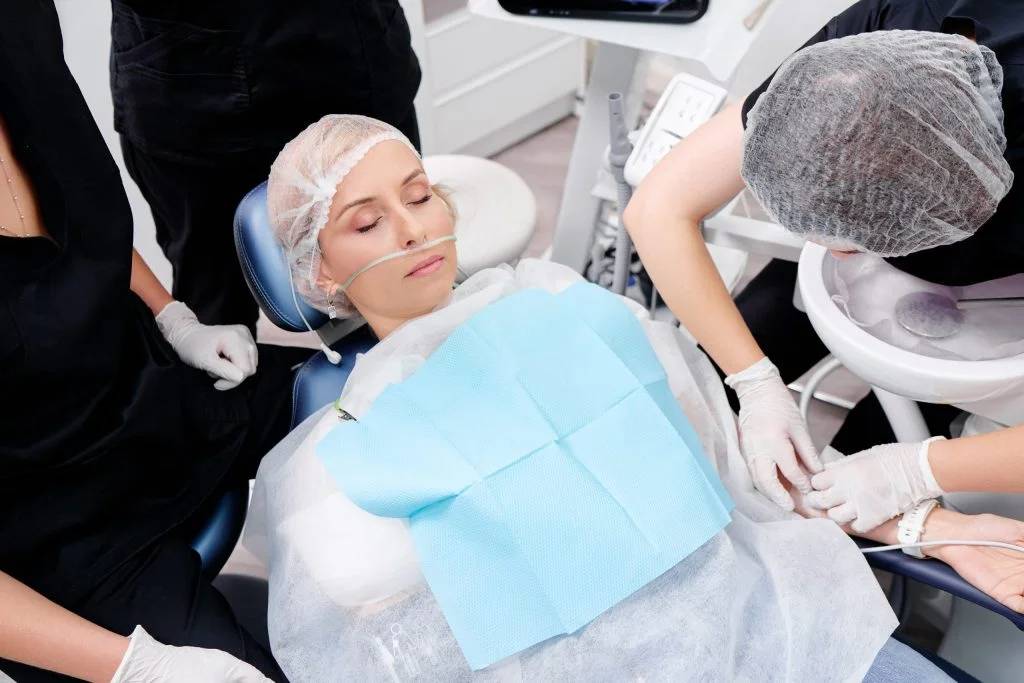
Quick Answer
Eating before IV sedation in Exeter, ON is generally not permitted. Most patients must stop eating solid food six to eight hours beforehand and stop clear liquids about two hours before their appointment. At Exeter Dental, our sedation team gives you exact fasting times based on your health and procedure, so always follow the instructions we provide.
Few questions cause more pre-appointment confusion than what you can eat and drink beforehand. Understanding the rules for eating before IV sedation in Exeter, ON protects you from a delayed procedure and, more importantly, keeps you safe. At Exeter Dental on Main Street North, we hear the same worries and half-truths repeatedly, so let’s clear them up with straight answers rather than guesswork.
Why Fasting Before IV Sedation Actually Matters
IV sedation relaxes you deeply, and that relaxation also dulls the reflexes that normally protect your airway. Consequently, if your stomach holds food or liquid, there is a small risk of that content coming back up and entering your lungs. This complication, called aspiration, is rare but serious. Fasting empties the stomach, which dramatically lowers that risk.
Anaesthesia and sedation providers across Canada follow the same core principle. According to guidance from the Royal College of Dental Surgeons of Ontario, sedation must follow strict safety protocols, and pre-procedure fasting is a fundamental part of that framework. Therefore, the empty-stomach rule is not an arbitrary inconvenience; it is a genuine safeguard.
The Typical Timeline
While your exact instructions come from our team, most IV sedation plans follow a familiar pattern. Specifically, you should stop eating solid food and heavy liquids such as milk roughly six to eight hours before your appointment. Additionally, clear liquids like water or apple juice are usually allowed up until about two hours before. However, these windows shift depending on your medical history, so your personalized instructions always take priority.
Busting the Most Common Myths About Eating Before Sedation
Misinformation spreads quickly, and several stubborn myths keep patients confused. Let’s address the ones we hear most often at our Exeter office.
Myth: “A small snack won’t hurt anything.”
Unfortunately, this is one of the riskiest assumptions. Even a granola bar or a piece of toast counts as breaking your fast. Furthermore, a partially full stomach still carries aspiration risk, and it may force us to reschedule your appointment for safety. When in doubt, treat “nothing to eat” as absolute.
Myth: “Coffee is just a liquid, so it’s fine.”
Black coffee and tea are clear liquids in the technical sense, yet cream, milk, and sugar change that equation. Additionally, many people forget that a splash of milk turns a permitted drink into a restricted one. Consequently, we ask that you avoid coffee altogether unless your provider explicitly clears it.
Myth: “Chewing gum or mints don’t count.”
Chewing stimulates stomach acid and saliva production, which is exactly what fasting aims to minimize. Therefore, gum, mints, and hard candy are off-limits before IV sedation, even though you never swallow them as food.
Myth: “I can take all my usual pills with a big glass of water.”
Some medications should continue, while others must pause before sedation. Specifically, we review your prescriptions in advance and tell you which to take with a small sip of water. Never guess on this point; instead, ask us directly during your pre-sedation consultation.
Real Patient Questions We Answer Every Week
Beyond the myths, certain practical questions come up constantly. Here are honest, direct responses.
Patients frequently ask whether children follow the same rules. Generally, children have shorter fasting windows because their bodies process differently, so we always give age-specific guidance. Another common question involves diabetes; if you manage blood sugar, we coordinate your fasting and medication carefully to keep you stable throughout.
Many also wonder what happens if they accidentally eat. The answer is simple: tell us immediately and honestly. We would far rather reschedule than proceed unsafely. Additionally, a trusted adult must drive you home afterward, because the sedation lingers for hours and dulls your judgment and coordination.
How Exeter Dental Keeps Sedation Safe and Comfortable
Our practice offers IV sedation, oral sedation, and nitrous oxide sedation under one roof, so we can match the right approach to your anxiety level and procedure. Moreover, our team combines modern monitoring technology with a calm, reassuring environment designed to ease nervous patients. You can explore all of our sedation and dental services to understand which option might suit you.
We also believe informed patients feel calmer. Consequently, we explain every fasting instruction in plain language and answer questions before your appointment day. The Canadian Dental Association emphasizes patient education as a cornerstone of quality care, and that principle guides how we prepare every sedation patient in Exeter.
Frequently Asked Questions
How many hours before IV sedation should I stop eating?
Most patients stop solid food six to eight hours beforehand and clear liquids about two hours before. However, your exact fasting window depends on your health, so always follow the specific instructions we give you.
Can I drink water before IV sedation?
Usually, small amounts of clear water are permitted up to roughly two hours before your appointment. Nevertheless, confirm your personal cut-off time with our team, since instructions vary by patient.
What happens if I accidentally eat before my appointment?
Tell us right away. For your safety, we may reschedule the procedure rather than risk aspiration. Honesty protects you, and rescheduling is always the safer choice.
Do I need someone to drive me home after IV sedation?
Yes, absolutely. The sedation impairs coordination and judgment for hours, so a responsible adult must accompany you and drive you home safely.
Ready to Plan Your Sedation Visit?
Clear preparation makes sedation smoother and safer, and our team is happy to walk you through every step. If you have questions about fasting, medications, or which sedation option fits you best, contact Exeter Dental today. We will give you precise, personalized instructions well before your appointment.
Sources & References
- Royal College of Dental Surgeons of Ontario (RCDSO) — sedation and anaesthesia standards
- Canadian Dental Association (CDA) — patient education and oral health resources