
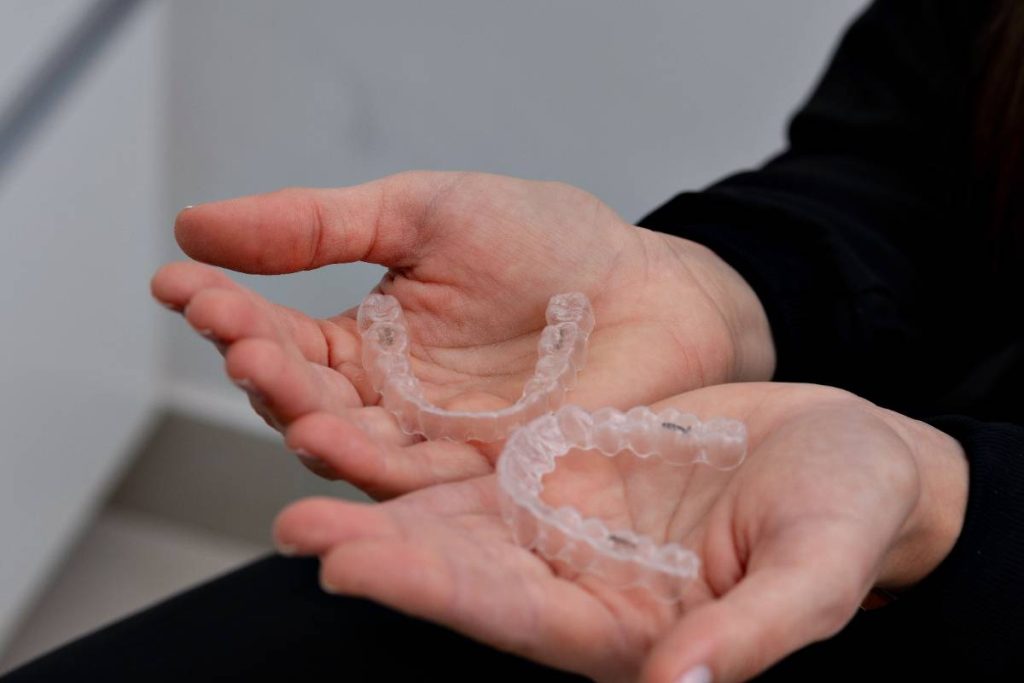
Quick Answer: Clear aligners are a series of custom, removable trays that shift your teeth a small amount at a time. They suit many adults with mild to moderate crowding, spacing or certain bite issues, provided your teeth and gums are healthy first. At Exeter Dental, treatment starts with an exam and digital imaging. After that, you wear each set of trays about 22 hours a day and come in for regular progress checks.
Maybe a front tooth has started to drift. Or perhaps you had braces as a teen and never wore your retainer. Either way, you have probably wondered whether clear aligners in Exeter could fix the problem without metal brackets. This guide explains how aligners actually move teeth, which adults tend to do well with them, and what treatment looks like from the first visit to the final retainer. It also covers where aligners fall short, because a good fit matters more than a quick sale.
How Do Clear Aligners Work?
Clear aligners move teeth with gentle, controlled pressure, one small step at a time. Each tray is shaped slightly differently from the last. Consequently, when you switch to the next tray, your teeth follow its shape by a fraction of a millimetre.
Your bone and the periodontal ligament around each root respond to that steady pressure by slowly remodelling. That is the same biological process that makes traditional braces work. The difference lies in how the force is delivered. Instead of wires and brackets, aligners use smooth plastic, sometimes combined with small tooth-coloured bumps called attachments. These attachments give the trays extra grip, so they can rotate or tip a tooth more precisely.
What the research says
Aligner technology has improved steadily over the past two decades. For example, a narrative review in Cureus (2024) describes clear aligner therapy as a convenient and aesthetic alternative to fixed appliances for adults with misaligned teeth. The same review also discusses indications and contraindications, which is a useful reminder that aligners are not a universal solution. Similarly, a systematic review in The Angle Orthodontist assessed how well aligners control different types of tooth movement. In short, some movements are more predictable than others. That is exactly why a careful assessment comes first.
Who Is a Good Fit for Clear Aligners in Exeter?
Adults with mild to moderate alignment concerns are usually the best candidates. Specifically, aligners often work well for:
- Crowded or overlapping front teeth
- Small gaps between teeth
- Teeth that have relapsed after childhood braces
- Some overbite, underbite or crossbite cases, depending on severity
However, candidacy depends on more than how your smile looks. Your gums must be healthy before any tooth movement begins. If you have active gum disease, moving teeth can worsen bone loss. For that reason, our team may recommend clear aligner treatment only after a cleaning or periodontal care brings your gums under control.
When another option may suit you better
Severe rotations, large skeletal bite differences and teeth that need significant vertical movement can be harder to manage with trays alone. In addition, aligners rely heavily on discipline. If you know you will leave them in a drawer, results will suffer. We would rather tell you that honestly at the consultation than discover it halfway through treatment. In some cases, cosmetic bonding or veneers may address a minor concern faster than tooth movement would.
What to Expect During Aligner Treatment
Treatment follows a predictable sequence, and most adults find it fits easily into a working week. Here is how it typically unfolds at our Exeter office.
1. Exam and records
First, your dentist completes a full exam, checks your gum health and takes X-rays and digital images. Furthermore, we look for cavities or worn fillings that should be repaired before trays are made. The Canadian Dental Association notes that regular checkups help catch problems early, and that principle applies doubly before orthodontic work.
2. Your treatment plan
Next, we map out how your teeth will move and roughly how many trays you will need. We explain the plan in plain language, including what is realistic and what is not.
3. Wearing your trays
You wear each set for about 22 hours a day. Meanwhile, you remove them only to eat, drink anything other than water, and brush. Most people notice pressure for a day or two after each switch. That pressure is a sign the trays are working, and it usually fades quickly.
4. Progress visits
Additionally, you will come in periodically so we can confirm your teeth are tracking as planned. If a tooth lags behind, we can adjust the plan rather than let small problems grow.
5. Retention
Finally, once your teeth reach their new positions, you will need a retainer. Teeth naturally try to drift back, especially in the first months. Wearing a retainer as directed is what protects your investment for the long term.
Daily Life With Clear Aligners
Most adults adapt within the first week. Speech may feel slightly different for a few days, although that usually settles fast. Because you remove the trays to eat, there are no food restrictions like those that come with brackets.
On the other hand, hygiene becomes more important, not less. Food or sugary drinks trapped under a tray sit against your enamel for hours. Therefore, brush before putting trays back in and rinse them daily with cool water. The Ontario Dental Association’s tips for adults offer practical reminders about brushing, flossing and diet that pair well with aligner wear.
Clear Aligners Compared With Other Options
Aligners are nearly invisible and removable, which is why so many adults prefer them. Nevertheless, they require you to take responsibility for wear time. Fixed braces, by contrast, work around the clock whether you remember them or not. Meanwhile, purely cosmetic treatments like bonding can change the look of a tooth without moving it at all. The right choice depends on your bite, your goals and your habits. During your consultation, we walk through each option so you can decide with full information.
Starting Clear Aligners in Exeter, ON
Exeter Dental brings general, cosmetic, orthodontic and periodontal care together under one roof. As a result, if your gums need attention or a tooth needs a filling before treatment, you do not have to visit several offices. We also accept the Canadian Dental Care Plan for eligible services, and our team can help you understand what your insurance may cover. Patients come to us from Exeter and nearby Huron County communities, and we schedule progress visits with busy work and family lives in mind.
Frequently Asked Questions
How long does clear aligner treatment take for adults?
Many adult cases take several months to about a year or more. The exact timeline depends on how far your teeth need to move and how consistently you wear your trays.
Do clear aligners hurt?
Most people feel mild pressure for a day or two after switching trays. It is usually described as tightness rather than pain, and it fades as teeth adjust.
Am I too old for clear aligners?
There is no upper age limit. What matters most is healthy gums and supporting bone. An exam at our office will show whether your teeth are ready to move.
Will I need a retainer afterward?
Yes. A retainer holds your teeth in their new positions while the surrounding bone stabilizes. Without one, teeth tend to shift back over time.
Book Your Clear Aligner Consultation
If you are curious whether clear aligners in Exeter could work for your teeth, the simplest next step is an assessment. We will examine your bite, review your goals and give you an honest recommendation. Contact Exeter Dental today to book your visit.
Sources & References
- Stability and Success of Clear Aligners in Orthodontics: A Narrative Review (Cureus, 2024)
- Efficacy of clear aligners in controlling orthodontic tooth movement: a systematic review (Angle Orthod, 2015)
- Canadian Dental Association: Regular Dental Checkups
- Ontario Dental Association: Tips for Adults